Table Of Contents
AI in Marketing Is Evolving Faster Than Ever
Artificial intelligence has moved far beyond being just another productivity tool. In 2026, AI is becoming an essential part of modern marketing, helping businesses create better content, personalise customer experiences, optimise advertising campaigns, and make smarter decisions using data.
The biggest change isn’t simply that businesses are using AI—it’s how they’re using it. Companies are shifting from experimenting with AI to integrating it into their everyday marketing workflows and customer journeys.
Whether you’re running a small business or managing a growing company, understanding these changes can give you a significant competitive advantage.
The Biggest AI Marketing Trends in 2026
AI Is Becoming a Marketing Assistant, Not Just a Writing Tool
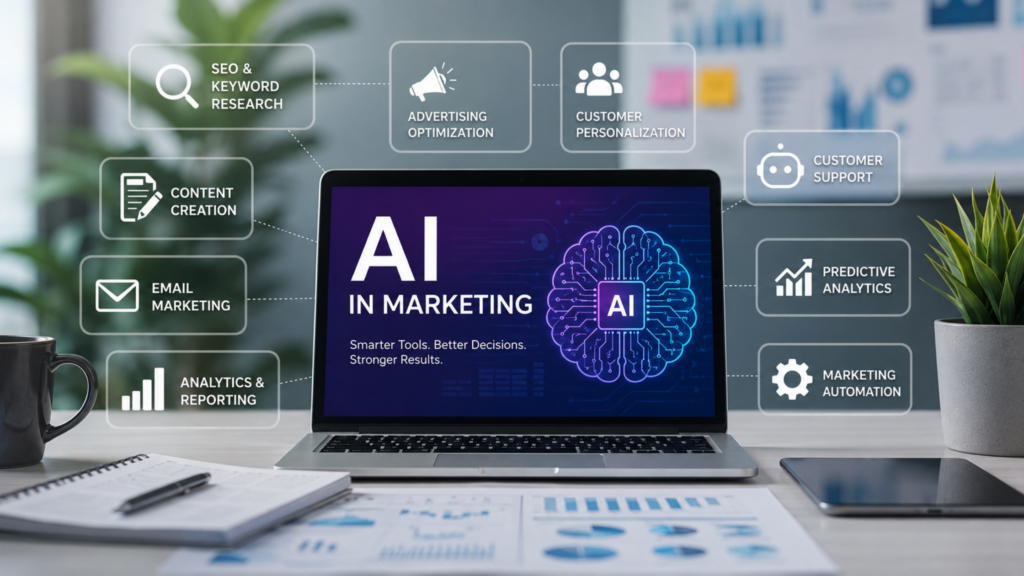
Many businesses first adopted AI to write blog posts or social media captions. Today, AI can support almost every stage of the marketing process, including:
- Market research
- Competitor analysis
- Keyword research
- SEO optimisation
- Campaign planning
- Email marketing
- Customer segmentation
- Performance reporting
- Ad copy generation
Rather than replacing marketers, AI is allowing teams to spend less time on repetitive tasks and more time focusing on strategy and creativity. Marketing leaders increasingly view AI as a tool that enhances human expertise instead of replacing it.
AI Search Is Changing SEO Forever
Traditional Google rankings are no longer the only way customers discover businesses.
People are increasingly asking questions directly to AI assistants like:
- ChatGPT
- Google Gemini
- Microsoft Copilot
- Claude
- Perplexity
Instead of presenting ten blue links, these platforms often generate complete answers using trusted sources.
This has introduced a new optimisation strategy known as:
- Generative Engine Optimisation (GEO)
- Answer Engine Optimisation (AEO)
Businesses now need content that doesn’t just rank well—it also needs to be understandable, trustworthy, and easy for AI systems to reference.
What this means for your website
Your content should include:
- Clear headings
- Direct answers to common questions
- Original expertise
- Up-to-date information
- Helpful FAQs
- Strong website authority
Personalisation Is Becoming Smarter
AI can analyse customer behaviour in real time to deliver highly personalised experiences.
Examples include:
- personalised product recommendations
- dynamic website content
- customised email campaigns
- predictive offers
- personalised advertisements
Instead of showing every visitor the same message, AI helps businesses deliver the right content to the right audience at the right time.
AI Advertising Is Becoming More Automated
Platforms like Google Ads and Meta Ads continue expanding their AI capabilities.
Modern advertising platforms now automatically optimise:
- bidding
- audience targeting
- creative variations
- campaign budgets
- performance forecasting
Instead of manually adjusting every campaign setting, marketers increasingly focus on defining business goals while AI handles much of the optimisation process. Major brands and agencies are using AI to dramatically shorten campaign production and improve targeting.
AI Agents Are the Next Big Step
One of the most exciting developments is the rise of AI agents.
Unlike traditional AI chatbots that simply answer questions, AI agents can perform entire workflows with minimal supervision.
For marketers, this could include:
- researching competitors
- creating content briefs
- generating blog drafts
- scheduling social media posts
- analysing campaign performance
- identifying SEO opportunities
- preparing monthly reports
Instead of completing one task at a time, AI agents can execute multi-step processes, making them a powerful addition to marketing teams.
AI Tools Every Business Should Be Using
Not every business needs dozens of AI tools. A carefully selected toolkit can dramatically improve efficiency without overwhelming your team.
Content Creation
Use AI to:
- generate blog outlines
- write first drafts
- create social media ideas
- rewrite existing content
- brainstorm headlines
Always review and edit AI-generated content before publishing to ensure it reflects your brand voice.
SEO
AI can help with:
- keyword research
- content optimisation
- topic clustering
- internal linking suggestions
- competitor analysis
- meta titles and descriptions
Combined with human expertise, AI makes SEO significantly faster while maintaining quality.
Customer Support
AI chatbots can answer common questions 24/7, helping businesses:
- reduce response times
- qualify leads
- schedule appointments
- recommend products
- improve customer satisfaction
Email Marketing
AI can assist with:
- subject line testing
- personalised email content
- customer segmentation
- automated email sequences
- campaign performance analysis
Analytics
Instead of manually reviewing dashboards, AI can summarise:
- campaign performance
- conversion trends
- traffic changes
- customer behaviour
- opportunities for improvement
This allows businesses to make faster, data-driven decisions.
Don’t Let AI Replace Your Brand Voice
One of the biggest mistakes businesses make is publishing AI-generated content without adding human insight.
AI can write quickly—but it doesn’t understand your customers, company culture, or unique experience.
The best-performing businesses combine:
- AI efficiency
- human creativity
- industry expertise
- authentic storytelling
This creates content that builds trust rather than sounding generic. Marketing experts continue to emphasise that creativity, strategy, and emotional storytelling should remain human-led.
Responsible AI Matters
As AI becomes more integrated into business operations, companies also need to think about governance and transparency.
For businesses operating in Europe, evolving regulations such as the EU AI Act make it increasingly important to understand how AI tools are used, especially when they influence customer interactions, recruitment, or decision-making. Building clear policies now will make future compliance much easier.
The Future Belongs to Businesses That Use AI Wisely
AI is no longer a competitive advantage reserved for large corporations. Businesses of every size now have access to powerful tools that improve productivity, strengthen marketing campaigns, and deliver better customer experiences.
The companies that succeed won’t be the ones using the most AI—they’ll be the ones using it strategically.
By combining AI with creativity, expertise, and a clear marketing strategy, businesses can work more efficiently while building stronger relationships with their customers.
At Crystal Web Solutions, we help businesses combine modern AI-powered marketing with proven digital strategies, ensuring technology supports growth without replacing the human expertise that makes every brand unique.
FAQ
Is AI replacing digital marketers?
No. AI is automating repetitive tasks, but strategy, creativity, branding, and relationship building still require human expertise.
What is the best AI tool for marketing?
There isn’t a single best tool. Many businesses combine AI assistants for content creation with specialised tools for SEO, advertising, analytics, and customer support.
Should small businesses use AI?
Absolutely. AI can save time, improve marketing performance, and help small businesses compete more effectively without significantly increasing costs.
Does AI improve SEO?
Yes—when used correctly. AI can speed up research, content planning, and optimisation, but high-quality, original content remains essential for long-term search performance and AI visibility.