Digital advertising is entering a new era. For years, businesses have relied on platforms such as Google Ads, Facebook and Instagram to reach potential customers. Now, another major advertising channel is emerging: ChatGPT Ads.
OpenAI began testing advertising in ChatGPT in the United States in February 2026 and has since expanded the platform into additional markets, including Europe. For marketers, this creates an entirely new opportunity: reaching potential customers while they are actively researching, comparing options and making decisions.
But how do ChatGPT Ads actually work, and should businesses start paying attention?
Table Of Contents
What Are ChatGPT Ads?
ChatGPT Ads are sponsored placements that can appear alongside conversations within ChatGPT.
Unlike traditional search advertising, where advertisers primarily compete for keywords, ChatGPT can understand the broader context and intent behind a conversation.
Imagine someone asking:
“What is the best accounting software for a small ecommerce business?”
Instead of targeting only a keyword such as accounting software, advertising in ChatGPT can take into account the wider context of the conversation — including what the user is trying to achieve.
This creates a potentially powerful advertising environment because businesses can appear when users are already exploring options, comparing alternatives or considering a purchase.
Importantly, advertisements are clearly labelled and remain separate from ChatGPT’s answers. Advertising does not determine or change the answers generated by ChatGPT.
How Do Ads Appear in ChatGPT?
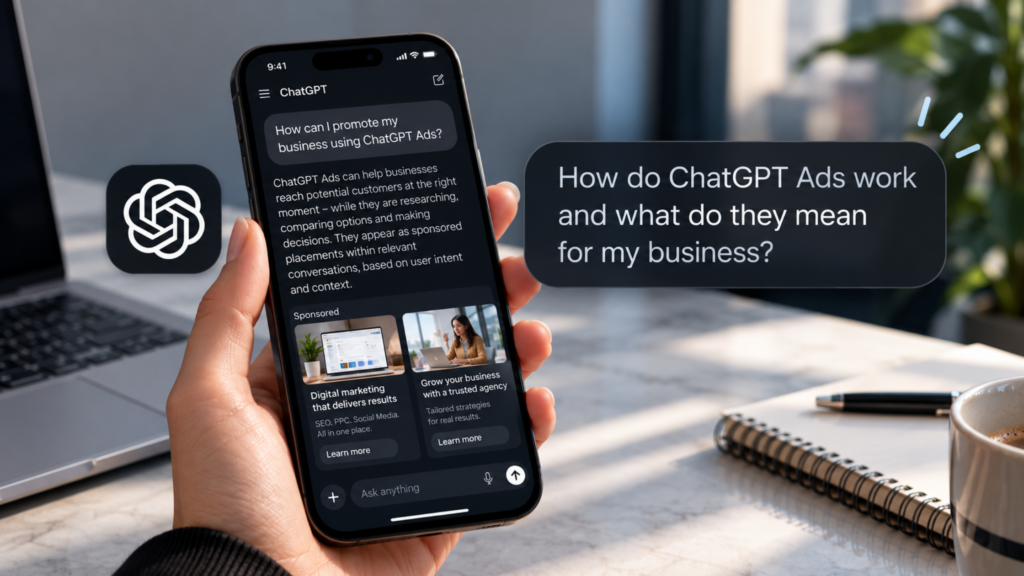
Currently, ads can appear below a ChatGPT response.
A typical advertisement can include:
- the advertiser’s name and logo
- a headline
- descriptive copy
- an image
- a link to the advertiser’s landing page
The format may look relatively simple, but the context in which the advertisement appears is what makes ChatGPT Ads particularly interesting.
Instead of interrupting someone while they scroll through social media, the advertisement can appear during a conversation where the person has already expressed a relevant need.
That changes the role of advertising from simply capturing attention to potentially becoming part of the customer’s research journey.
ChatGPT Ads vs Google Ads
Google Ads and ChatGPT Ads may sometimes reach users at similar stages of the buying journey, but they approach intent differently.
With Google Search Ads, advertisers typically target keywords or search queries.
Someone might search:
“best CRM for small business”
With ChatGPT, that same person might have a much longer conversation:
“We have a team of five salespeople, currently track leads in spreadsheets and need something affordable that integrates with our email. What CRM options should we consider?”
The second example contains considerably more context.
This is one of the biggest potential differences between traditional search advertising and conversational advertising. AI platforms can understand not only what someone is searching for, but also the context around why they are searching for it.
Google Ads is unlikely to disappear because of this. Instead, ChatGPT Ads could become another important channel within the wider paid advertising ecosystem.
How Does ChatGPT Decide Which Ads to Show?
ChatGPT Ads are not based purely on traditional keyword matching.
The advertising system can consider signals such as the context and intent of the current conversation, the advertiser’s landing page, ad headline and description, advertiser-provided context hints and targeting settings.
Advertisers can provide context hints describing conversations, topics or keywords where their offer could be relevant. However, these do not function like exact-match keywords.
This means advertisers may need to rethink how campaigns are structured.
Instead of asking only:
“Which keywords should we target?”
Marketers may increasingly need to ask:
“In which conversations would our product genuinely be useful?”
That is a significant shift.
How Much Do ChatGPT Ads Cost?
ChatGPT Ads currently support different campaign objectives and buying models.
Advertisers can run campaigns focused on reach, clicks or conversions, with impression-based and click-based billing available depending on the campaign setup.
OpenAI’s advertiser guidance currently recommends starting CPC campaigns with a maximum bid of around $3–$5 per click, although actual costs will naturally depend on competition, relevance, targeting and campaign performance.
Advertisers can also measure metrics such as impressions, clicks, CTR, CPC, CPM and conversions.
This makes the platform increasingly similar to established performance advertising platforms — while the environment in which the advertising appears remains very different.
Why ChatGPT Ads Could Be Important for Businesses
The biggest opportunity may be intent.
Social media advertising often tries to generate demand while users are doing something completely unrelated to the advertiser.
Search advertising captures existing demand.
Conversational AI can potentially sit somewhere deeper within the research and decision-making process.
A person may use ChatGPT to:
- research a new product
- compare different services
- plan a holiday
- choose business software
- find solutions to a problem
- research a purchase
- evaluate different providers
For businesses, appearing naturally during these moments could become extremely valuable.
And the audience is already substantial. OpenAI reported in August 2026 that ChatGPT had surpassed one billion weekly active users, while tens of thousands of advertisers were already using ChatGPT Ads.
Advertising in ChatGPT Will Require Different Creative
Businesses should not simply copy their Google Ads campaigns into ChatGPT.
OpenAI recommends clear, specific and benefit-focused advertising copy that explains what a business offers, who the product or service is for and why it might be useful.
That makes sense in a conversational environment.
Generic copy such as:
“The #1 Solution for Your Business – Learn More Today!”
provides very little useful context.
Something more specific, such as:
“Accounting software designed for small ecommerce teams that want automated invoicing and expense tracking.”
gives the advertising system — and the potential customer — much more information.
The future of paid advertising may therefore reward businesses that communicate their value proposition extremely clearly.
What About Privacy?
Privacy is understandably one of the biggest questions surrounding advertising inside an AI assistant.
OpenAI states that advertisers do not receive users’ conversations, chat history, memories, names, email addresses, precise locations or IP addresses.
Ads can use the context of the current conversation to determine relevance, and additional signals may be used when users enable personalised advertising. However, the advertiser does not receive the underlying conversation.
Ads are also kept separate from ChatGPT’s generated answers.
This distinction will be important if conversational advertising is going to earn long-term user trust.
Should Businesses Start Using ChatGPT Ads?
For businesses already investing significantly in Google Ads, Meta Ads or other performance marketing channels, ChatGPT Ads are worth watching closely — and potentially testing.
The platform is still relatively new compared with established advertising ecosystems, which means best practices, formats and optimisation strategies will continue to evolve.
However, early adoption can provide businesses with valuable data about how customers behave in conversational environments.
Rather than immediately moving large portions of an advertising budget into ChatGPT, businesses can begin with controlled tests, measure traffic quality and conversions, and compare performance with existing acquisition channels.
The Bigger Picture: Search Is Becoming Conversational
ChatGPT Ads are part of a much larger change in digital marketing.
People are increasingly asking AI assistants questions they previously typed into search engines.
Instead of searching multiple websites, users can ask follow-up questions, refine their requirements and compare options within one conversation.
That means businesses need to think beyond traditional SEO and PPC.
The future of visibility online may involve three connected areas:
SEO — appearing in traditional search engines.
AI visibility — being referenced and discovered through AI-generated answers.
AI advertising — paying to reach relevant audiences within conversational AI platforms.
Businesses that understand how these channels work together will be better prepared as online discovery continues to evolve.
Final Thoughts
ChatGPT Ads are still a relatively new addition to the digital advertising landscape, but they show how quickly the way people discover businesses online is changing.
As users increasingly turn to AI to research products, compare services and make decisions, businesses may need to think beyond traditional search and social media advertising. Understanding where your customers are searching — and how they are using AI — will become an increasingly important part of a successful digital marketing strategy.
At Crystal Web Solutions, we help businesses stay ahead of changes in digital marketing, from SEO and Google Ads to social media, content marketing and emerging AI opportunities.
As platforms like ChatGPT continue to evolve, we’ll be watching how new advertising formats develop and what they mean for businesses looking to reach the right audience online.
Want to strengthen your digital marketing strategy? Get in touch with Crystal Web Solutions and let’s find the right channels for your business.