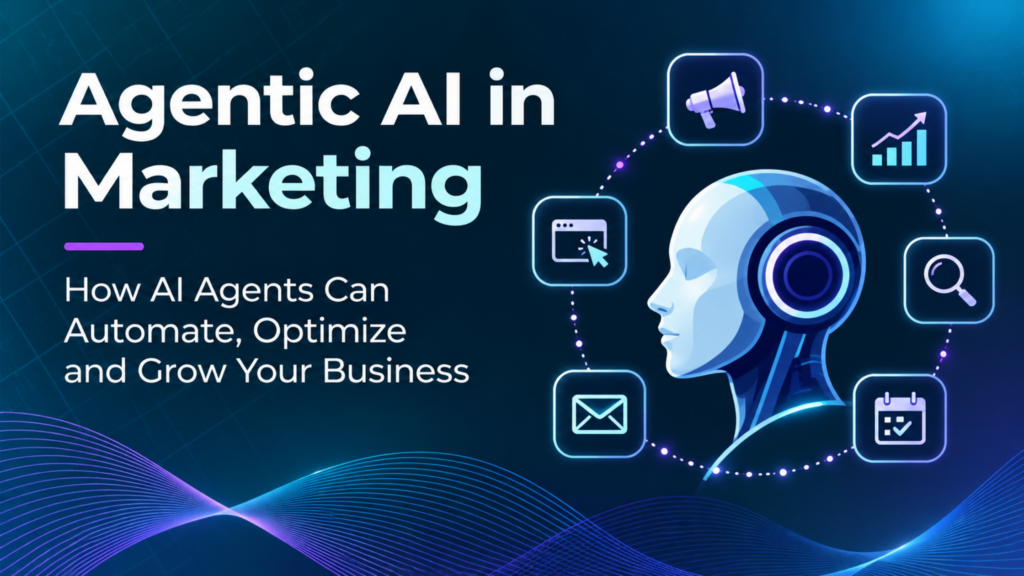
Artificial intelligence has already changed how businesses create content, analyze data, and communicate with customers. However, a new development is taking marketing automation further: agentic AI in marketing.
Unlike traditional AI tools that wait for instructions, agentic AI systems can plan tasks, make decisions within defined limits, and take actions to achieve specific goals. This technology is opening new opportunities for businesses looking to improve efficiency, optimize campaigns, and reduce repetitive work.
But what exactly is agentic AI, and how can businesses use it in their marketing strategies?
Table Of Contents
What Is Agentic AI in Marketing?
Agentic AI refers to artificial intelligence systems designed to work toward goals with a degree of autonomy. Instead of simply responding to individual prompts, AI agents can complete multiple connected tasks, evaluate results, and adjust their actions based on available information.
For example, a traditional AI tool might help a marketer write advertising copy. An agentic AI system could potentially analyze campaign performance, identify underperforming advertisements, suggest alternative copy, and implement approved changes through connected marketing platforms.
The main difference is that traditional AI primarily assists with tasks, while agentic AI can help execute workflows.
However, the level of independence depends on how the system is configured. Businesses can establish rules, approval requirements, and restrictions to ensure AI agents operate within appropriate boundaries.
Traditional AI vs. Agentic AI: What’s the Difference?
Although both technologies use artificial intelligence, they serve different purposes.
Traditional AI tools:
- Generate content based on user prompts.
- Answer questions and summarize information.
- Analyze data when requested.
- Typically require users to initiate individual tasks.
Agentic AI systems:
- Work toward predefined objectives.
- Plan and execute multiple connected steps.
- Interact with different tools and platforms.
- Monitor results and adjust workflows.
- Request human approval when necessary.
For instance, imagine a business wants to increase website conversions.
A traditional AI assistant could suggest improvements to landing page content. An agentic AI system could go further by reviewing analytics data, identifying potential conversion barriers, preparing alternative content, and coordinating an approved testing process.
This shift from individual assistance to coordinated execution is what makes agentic AI particularly interesting for digital marketing.
5 Ways Agentic AI Can Transform Digital Marketing
1. Smarter Advertising Campaign Management
Managing digital advertising campaigns requires continuous monitoring, testing, and optimization.
Agentic AI can help marketers analyze campaign performance across platforms such as Google Ads and Meta Ads, identify trends, and recommend improvements.
Depending on the available integrations and permissions, AI agents could:
- Monitor campaign performance against defined KPIs.
- Identify advertisements with declining conversion rates.
- Suggest adjustments to targeting or advertising copy.
- Detect unusual changes in advertising costs.
- Prepare performance summaries and optimization recommendations.
For example, an AI agent could identify that a campaign’s cost per lead has increased significantly and notify the marketing team with possible explanations and recommended actions.
Rather than replacing marketing specialists, these systems can help them respond faster and focus on strategic decisions.
2. More Efficient SEO Optimization
Search engine optimization involves multiple ongoing activities, including keyword research, content updates, technical audits, and performance monitoring.
Agentic AI in marketing can help coordinate these activities and reduce manual work.
An AI agent could monitor Google Search Console data, identify pages losing organic visibility, and recommend updates based on search performance.
It could also support tasks such as:
- Identifying content that needs updating.
- Detecting technical SEO issues.
- Finding internal linking opportunities.
- Monitoring keyword performance.
- Preparing SEO reports and content briefs.
For example, an AI agent could detect declining organic traffic to an important service page, investigate possible causes, and prepare recommendations for the marketing team.
However, human review remains essential to ensure that SEO recommendations are accurate, useful, and aligned with the business’s goals.
3. Personalized Customer Experiences
Customers increasingly expect relevant communication rather than generic marketing messages.
Agentic AI can help businesses deliver more personalized experiences by analyzing customer interactions and coordinating appropriate follow-up actions.
For example, an AI agent connected to an authorized customer relationship management (CRM) system could:
- Identify customer segments based on previous interactions.
- Recommend personalized email content.
- Coordinate follow-up communications.
- Help prioritize promising sales leads.
- Analyze engagement and suggest improvements.
Imagine a potential customer downloads a guide from a company’s website.
An AI agent could categorize the lead, prepare a relevant follow-up email, and recommend the next communication based on the customer’s subsequent engagement.
These workflows must respect privacy regulations, customer consent, and applicable marketing communication requirements.
4. Automated Marketing Reporting and Analytics
Marketing teams often spend significant time collecting information from different platforms.
Google Analytics 4, Google Ads, Meta Ads, and CRM systems all provide valuable data, but combining that information can be time-consuming.
Agentic AI can help simplify reporting by collecting authorized data, analyzing performance, and preparing actionable summaries.
For example, an AI agent could:
- Collect weekly marketing performance data.
- Compare results against previous periods.
- Identify unexpected changes in traffic or conversions.
- Highlight campaigns that require attention.
- Prepare reports with recommendations for the marketing team.
Instead of spending hours reviewing individual dashboards, marketers could receive a structured overview of what changed, why it might have happened, and which areas deserve further investigation.
Of course, AI-generated interpretations should be verified before making important business decisions.
5. Content Marketing and Social Media Workflows
Creating and managing content requires planning, research, writing, publishing, and performance analysis.
Agentic AI can support several stages of this process.
For example, an AI agent could analyze previously published blog posts, identify content gaps, prepare a monthly editorial calendar, and generate initial article briefs.
For social media, it could help organize content schedules, prepare captions, monitor engagement, and suggest future topics.
Businesses could also use AI agents to repurpose existing content into different formats.
A single blog article might become:
- A LinkedIn post.
- An Instagram carousel outline.
- An email newsletter.
- A short video script.
- Several social media captions.
Although AI can accelerate content production, human oversight is necessary to maintain originality, factual accuracy, and a consistent brand voice.
What Are the Benefits of Agentic AI for Small Businesses?
Agentic AI is not exclusively relevant to large companies with extensive marketing budgets.
Small and medium-sized businesses can also benefit, particularly when they have limited resources and need to manage several marketing channels simultaneously.
Time savings: AI agents can automate repetitive activities such as reporting, data monitoring, and preparing routine content.
Improved efficiency: Connected workflows can reduce the need to switch between different marketing platforms.
Faster decision-making: Automated monitoring can help businesses identify potential problems and opportunities earlier.
Better consistency: AI agents can follow established workflows, helping teams maintain regular reporting and marketing activities.
Scalability: Businesses may be able to manage more marketing activities without increasing manual workloads at the same rate.
However, implementing agentic AI also requires investment in suitable tools, integrations, testing, and oversight. The benefits depend on the quality of the data and how effectively the workflows are designed.
What Are the Risks and Challenges of Agentic AI?
Despite its potential, agentic AI is not a solution that businesses should implement without careful planning.
One of the main challenges is ensuring that automated decisions remain accurate and appropriate.
AI agents may misunderstand information, recommend ineffective actions, or produce incorrect outputs. When connected to advertising accounts, customer databases, or publishing platforms, these mistakes can have real consequences.
Businesses should pay particular attention to:
Data privacy and security: AI systems must handle customer and business information responsibly, with appropriate access permissions and safeguards.
Human oversight: Important decisions, particularly those involving advertising budgets, customer communications, or public content, should have suitable approval processes.
Data quality: AI agents depend on reliable information. Inaccurate tracking or incomplete analytics data can lead to poor recommendations.
Integration complexity: Connecting multiple marketing platforms may require technical expertise, additional software, and ongoing maintenance.
Costs and performance: Businesses should evaluate whether automation delivers measurable value compared with its implementation and operating costs.
The most effective approach is to introduce agentic AI gradually, starting with low-risk workflows before expanding its responsibilities.
How Can Businesses Start Using Agentic AI in Marketing?
Businesses do not need to automate their entire marketing strategy immediately.
A practical starting point is identifying repetitive activities that consume significant time but follow relatively predictable processes.
For example, a company might begin by automating its weekly marketing performance report.
The process could involve connecting relevant analytics tools, defining key metrics, configuring an AI agent to analyze results, and requiring a team member to review its recommendations.
Once the workflow has been tested and proven reliable, the business can explore additional applications.
A successful implementation generally involves five steps:
- Identify a clear objective. Decide which marketing process needs improvement.
- Evaluate available data and tools. Ensure the AI agent can access accurate, relevant information securely.
- Define responsibilities and limits. Establish which actions the agent can perform independently and which require approval.
- Test and monitor performance. Start with a limited workflow and review the results.
- Expand gradually. Introduce additional capabilities once the system demonstrates reliable performance.
The goal should not be automation for its own sake. It should be improving marketing performance while maintaining appropriate control.
Will Agentic AI Replace Digital Marketers?
As AI systems become more capable, it is natural to question whether marketing professionals will eventually become unnecessary.
However, marketing involves much more than executing repetitive tasks.
Understanding customers, developing creative strategies, positioning brands, and building meaningful relationships all require business context and human judgment.
Agentic AI can support these responsibilities by reducing administrative work and providing additional insights.
For example, an AI agent might identify that a campaign is underperforming, but a marketing specialist still needs to evaluate whether the recommended changes align with the company’s positioning, budget, and long-term objectives.
Rather than eliminating the need for marketing expertise, agentic AI is likely to change how marketers spend their time.
Professionals who understand how to combine AI capabilities with strategic thinking will be better positioned to benefit from this technology.
The Future of Agentic AI in Digital Marketing
Agentic AI represents a significant development in how businesses can manage digital marketing.
As AI agents become more capable of working across connected platforms, companies may increasingly use them to coordinate advertising, analytics, SEO, content marketing, and customer communications.
However, successful adoption will depend on more than choosing the latest technology.
Businesses will need clear objectives, reliable data, secure integrations, and effective human oversight.
The future of digital marketing is not simply about using more AI. It is about using AI more intelligently.
Companies that introduce agentic AI thoughtfully may gain valuable opportunities to improve efficiency, respond faster to changing conditions, and focus more attention on activities that drive business growth.
Ready to Make Your Digital Marketing More Efficient?
At Crystal Web Solutions, we help businesses build stronger digital marketing strategies through SEO, Google Ads, social media marketing, website development, and analytics.
Whether you want to improve your marketing performance, streamline reporting, or explore opportunities for smarter automation, having the right digital foundation is essential.
Contact Crystal Web Solutions to discover how we can help your business develop a more efficient, data-driven digital marketing strategy.