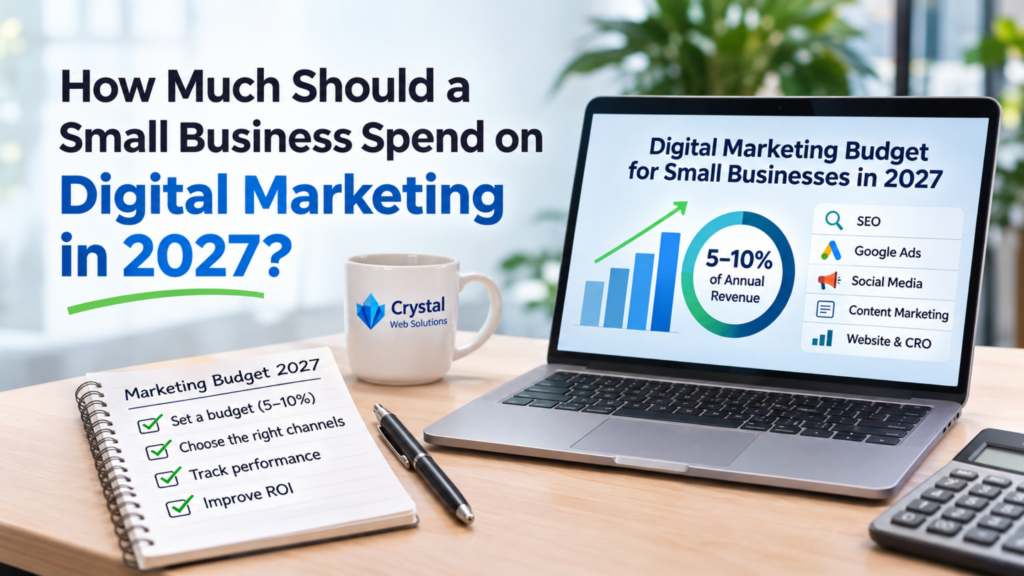
Running a small business in 2027 means competing for attention in an increasingly digital marketplace. With rising advertising costs, AI-powered search engines, and constantly evolving social media platforms, deciding how much to invest in marketing can be challenging. The good news? You don’t need an enormous budget to achieve meaningful results. What matters most is how effectively you use the resources available to you. A realistic digital marketing budget for small businesses often starts at around 5–10% of annual revenue, depending on the industry, competition, and business goals. However, this is a planning guideline rather than a fixed rule.
In this article, we’ll explore how much small businesses should consider spending on digital marketing in 2027, which channels deserve investment, and how to make every euro count.
Table Of Contents
1. How Much Should Small Businesses Budget for Digital Marketing in 2027?
One of the most common questions business owners ask is: How much should I spend on marketing?
The answer depends on several factors, including business size, revenue, industry, and growth ambitions.
According to Gartner’s 2026 CMO Spend Survey, marketing budgets averaged 7.8% of company revenue, compared with 7.7% in 2025. Although this research primarily represents large companies, it provides useful context for understanding marketing investment.
For small businesses planning their 2027 budgets, the following ranges can serve as practical starting points:
| Business situation | Suggested marketing budget |
|---|---|
| Established business with steady customers | 3–5% of annual revenue |
| Small business aiming for consistent growth | 5–10% of annual revenue |
| Startup or business entering a competitive market | 10–15% of annual revenue |
| Business launching a major new product or service | 10–20% temporarily, if financially sustainable |
These are illustrative planning ranges, not universal industry averages. They refer to total marketing investment, which may include offline activities as well as digital marketing.
Example: Digital Marketing Budget for a Small Business
Imagine a small business generating €200,000 in annual revenue.
If it allocates 7% of its revenue to marketing, its budget would look like this:
- Annual marketing budget: €14,000
- Monthly marketing budget: approximately €1,167
If the business focuses entirely on digital marketing, this amount could cover a combination of SEO, Google Ads, social media marketing, website improvements, and content creation.
However, businesses should also consider profitability. A company with narrow profit margins may need a smaller budget, while one with strong margins and ambitious growth targets may be able to invest more.
The goal is not simply to spend more, but to invest in activities that contribute to measurable business growth.
2. Where Should Small Businesses Spend Their Digital Marketing Budget?
Not every marketing channel deserves an equal share of your budget.
The right allocation depends on where your potential customers spend their time, how they search for products or services, and what motivates them to make a purchase.
Here are some of the most important digital marketing investments to consider in 2027.
Search Engine Optimization (SEO)
SEO remains one of the most valuable long-term investments for small businesses.
When potential customers search for services or products online, appearing in relevant search results can help your business attract visitors without paying for every click.
SEO activities may include:
- Optimizing website content and technical performance
- Conducting keyword research
- Creating helpful blog articles
- Improving local search visibility
- Optimizing website structure and internal linking
Unlike paid advertising, SEO can continue generating organic traffic after the initial investment. However, maintaining rankings and attracting visitors still requires ongoing work.
Best for: Businesses looking to build long-term visibility, generate organic leads, and reduce dependence on paid advertising.
Google Ads and Paid Search
Google Ads can be particularly effective for businesses that want to reach customers who are actively searching for their services.
For example, someone searching for “web design agency in Cyprus” may already be considering hiring a professional.
Paid search allows businesses to target these high-intent searches and attract relevant website visitors.
However, successful campaigns require more than simply increasing advertising spend.
Businesses should focus on:
- Selecting relevant keywords
- Excluding irrelevant searches
- Creating compelling advertisements
- Optimizing landing pages
- Tracking leads and conversions
- Monitoring cost per acquisition
Best for: Businesses seeking measurable lead generation, immediate visibility, or support for specific promotions.
Social Media Marketing
Social media continues to play an important role in helping small businesses build brand awareness, connect with customers, and promote their products or services.
Platforms such as Instagram, Facebook, LinkedIn, and TikTok offer different opportunities depending on the target audience.
For example:
- Instagram can support visual brands, hospitality businesses, and beauty-related companies.
- Facebook can help local businesses engage with communities and promote services.
- LinkedIn can be particularly useful for B2B companies and professional services.
- TikTok may help businesses reach audiences through engaging short-form video content.
Rather than trying to maintain an active presence on every platform, small businesses should prioritize the channels that are most relevant to their customers.
Best for: Building brand awareness, maintaining customer relationships, and reaching new audiences.
Website Optimization and Conversion Rate Optimization (CRO)
Your website is often the first meaningful interaction potential customers have with your business.
Even the best advertising campaigns can struggle if visitors arrive on a website that is slow, confusing, or difficult to navigate.
Investing in website improvements can help businesses generate more leads from their existing traffic.
Important areas include:
- Mobile-friendly design
- Fast loading times
- Clear calls to action
- Simple contact forms
- Trust signals such as reviews and testimonials
- Easy navigation and accessible content
For example, improving a landing page’s conversion rate from 2% to 3% means generating 50% more conversions from the same number of visitors, assuming traffic quality remains unchanged.
Best for: Businesses already receiving website traffic but struggling to convert visitors into customers.
Content Marketing and AI Search Visibility
In 2027, content marketing should go beyond publishing articles simply to target keywords.
As people increasingly discover information through AI-powered search experiences, businesses should focus on creating content that is useful, credible, and easy to understand.
This includes optimizing content for traditional search engines while also considering Answer Engine Optimization (AEO) and Generative Engine Optimization (GEO).
Practical activities include:
- Answering frequently asked customer questions
- Publishing informative and original blog articles
- Creating clear service and product descriptions
- Adding relevant structured data where appropriate
- Maintaining accurate business information
- Demonstrating expertise through useful content
Although no strategy can guarantee visibility in AI-generated answers, clear and authoritative content can improve how easily search systems understand your business.
Best for: Businesses aiming to strengthen their online authority and improve long-term discoverability.
3. Example of a €1,000 Monthly Digital Marketing Budget
A monthly budget of €1,000 can be a useful starting point for a small business that wants to build its online presence.
Here is an example of how that budget could be distributed:
| Marketing activity | Monthly budget |
|---|---|
| Google Ads | €350 |
| SEO and content creation | €250 |
| Social media marketing | €200 |
| Website optimization | €100 |
| Analytics and marketing tools | €50 |
| Testing and experimentation | €50 |
| Total | €1,000 |
This is an illustrative allocation rather than a recommendation for every business.
It assumes that production and management costs fit within the listed amounts. Businesses working with an agency should account for management fees separately or adjust the allocation accordingly.
For some businesses, investing most of the budget in Google Ads may deliver better results. Others may benefit more from SEO, local search optimization, or social media.
The most important principle is to prioritize the channels that are most likely to generate valuable business outcomes.
4. How to Calculate Your Digital Marketing Budget Based on Business Goals
While allocating a percentage of revenue is a convenient starting point, a more strategic approach involves calculating your budget based on the customers you want to acquire.
Let’s look at an example.
Imagine your business wants to acquire 20 new customers per month.
You know that:
- Your website converts 5% of qualified leads into customers.
- Your average cost per qualified lead is €10.
- Your goal is to acquire 20 new customers.
To achieve this, you would need approximately 400 qualified leads.
At €10 per lead, your estimated monthly lead generation budget would be €4,000.
This calculation is simplified and assumes stable conversion rates and lead costs. It also excludes additional marketing expenses.
Before committing to this budget, consider how much each customer is worth to your business.
If a new customer generates €1,000 in revenue with a strong profit margin, the investment may be financially attractive.
However, if a customer generates only €50 in revenue, the same acquisition cost may not be sustainable.
This is why understanding customer acquisition cost (CAC), customer lifetime value (CLV), and profit margins is essential when planning marketing investment.
5. Should Small Businesses Increase Their Marketing Budget in 2027?
Increasing your marketing budget is not automatically the best way to improve results.
Before spending more, evaluate how effectively your existing marketing activities perform.
Consider increasing your budget when:
- Your campaigns consistently generate profitable customers.
- You have identified opportunities to reach additional relevant audiences.
- Your website converts visitors effectively.
- Your business has the capacity to handle additional demand.
- Your growth objectives require greater investment.
On the other hand, increasing advertising spend may not solve problems caused by poor targeting, ineffective landing pages, or unclear messaging.
For example, if your Google Ads campaigns attract visitors but very few submit a contact form, improving the landing page may be more valuable than doubling the advertising budget.
Optimization should come before expansion.
6. Digital Marketing Trends That Could Influence Budgets in 2027
The digital marketing landscape continues to evolve, and businesses planning for 2027 should consider several developments.
AI-Powered Marketing Tools
Artificial intelligence is changing how businesses create content, analyze campaign performance, and automate marketing activities.
AI tools can support keyword research, reporting, content planning, and customer communication.
However, businesses should avoid investing in tools simply because they are new.
The priority should be selecting technologies that solve specific problems, save time, or improve marketing performance.
AI Search and Changing Customer Discovery
Traditional search engines remain important, but AI-powered search experiences are creating additional ways for customers to discover businesses.
In 2027, small businesses should consider how their content appears across both conventional search results and AI-generated answers.
This makes high-quality content, clear website structure, and consistent brand information increasingly important areas to evaluate.
First-Party Data and Measurement
Understanding customer behavior is essential for making informed marketing decisions.
Tools such as Google Analytics 4, Google Tag Manager, and reporting dashboards can help businesses measure website performance and campaign outcomes.
Small businesses should prioritize accurate conversion tracking and appropriate privacy practices before making major advertising investments.
Marketing Automation
Automation can help businesses reduce repetitive work and improve customer communication.
Examples include automated email sequences, lead follow-ups, customer segmentation, and scheduled reporting.
For businesses with limited resources, carefully implemented automation can improve efficiency without requiring additional staff.
7. Common Digital Marketing Budget Mistakes Small Businesses Should Avoid
Even a generous marketing budget can produce disappointing results if it is not managed strategically.
Here are some common mistakes to avoid:
Spreading the budget across too many channels. Trying to invest in every platform often results in insufficient resources to make any single channel effective.
Focusing only on advertising. Paid campaigns can generate traffic, but website quality, SEO, and customer experience also influence results.
Ignoring performance data. Without tracking conversions and acquisition costs, it becomes difficult to identify which activities are profitable.
Expecting immediate results from every channel. SEO and content marketing typically require more time than paid advertising to demonstrate their full value.
Failing to review the budget regularly. Marketing performance changes over time. Monthly reviews help businesses identify opportunities and reduce unnecessary spending.
A successful digital marketing strategy requires continuous testing, analysis, and improvement.
8. How to Make the Most of a Limited Digital Marketing Budget
If your business has limited resources, focus on efficiency rather than trying to compete with larger companies on spending.
Start by identifying your most valuable customer segments and the channels they use.
Invest in a professional, well-optimized website that clearly communicates what your business offers.
Build a strong foundation through SEO, relevant content, and accurate local business information.
When using paid advertising, start with focused campaigns and realistic objectives.
Most importantly, measure results consistently.
A smaller, carefully managed marketing budget can outperform a larger budget that lacks a clear strategy.
9. Should You Manage Digital Marketing Yourself or Hire an Agency?
Many small business owners initially manage their own social media accounts, advertising campaigns, and website updates.
While this can reduce external costs, it also requires time, technical knowledge, and continuous learning.
Working with a digital marketing agency can help businesses develop a coordinated strategy and avoid costly mistakes.
An experienced agency can support:
- Website development and optimization
- SEO and content marketing
- Google Ads campaign management
- Social media marketing
- Conversion tracking and analytics
- Digital marketing strategy and performance reporting
The decision should depend on your budget, internal resources, and the complexity of your marketing activities.
For many small businesses, outsourcing selected activities can provide a practical balance between cost and expertise.
Final Thoughts: Invest Smarter, Not Just More
So, how much should a small business spend on digital marketing in 2027?
For many businesses, allocating approximately 5–10% of annual revenue to marketing can provide a useful starting point. However, the ideal investment depends on your profitability, competition, customer acquisition costs, and growth objectives.
Rather than focusing exclusively on the amount you spend, consider what your marketing investment actually delivers.
A successful digital marketing strategy combines clear objectives, the right channels, accurate measurement, and continuous optimization.
At Crystal Web Solutions, we help businesses make smarter digital marketing decisions. From website development and SEO to Google Ads, social media marketing, and analytics, our goal is to help you build an effective online presence and turn your marketing investment into measurable results.
Planning your digital marketing budget for 2027? Contact Crystal Web Solutions and let’s create a strategy that fits your business goals and budget.