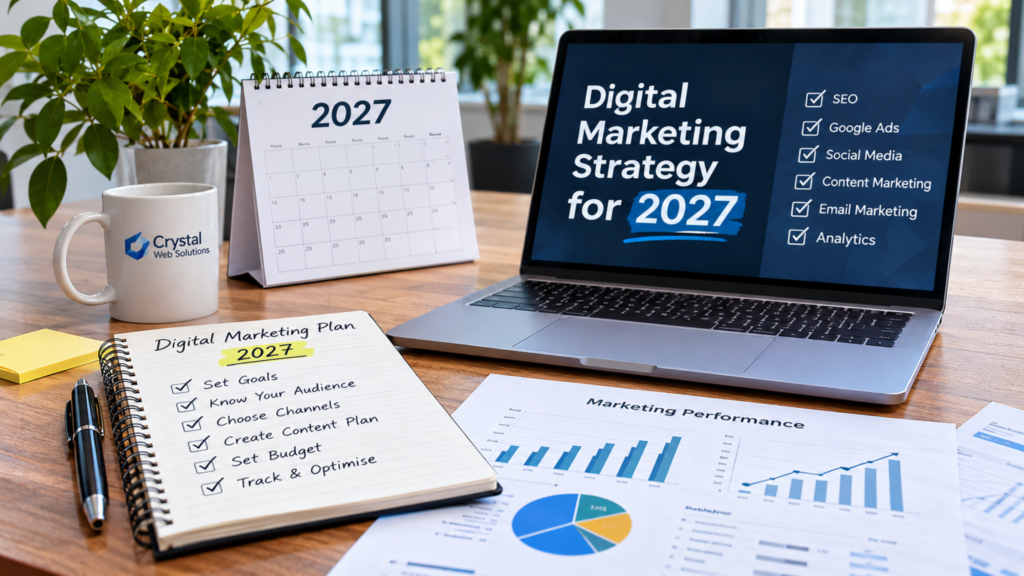
As 2027 approaches, businesses have an opportunity to rethink their online presence, evaluate their performance and prepare for another year of growth. A well-planned digital marketing strategy can help businesses attract the right customers, improve brand awareness and make better use of their marketing budget.
With artificial intelligence, changing consumer behaviour and evolving search habits, simply having a website or posting regularly on social media is no longer enough. Businesses need a clear strategy that connects their marketing activities with measurable business objectives.
Here is how to build an effective digital marketing strategy for 2027.
Table Of Contents
1. Review Your Marketing Performance in 2026
Before planning your next steps, take time to understand what worked and what did not during the past year.
Review your performance across different digital marketing channels, including:
- Website traffic and conversions
- Organic search performance
- Social media engagement
- Google Ads and paid social media campaigns
- Email marketing performance
- Customer acquisition costs
- Return on advertising spend (ROAS)
Tools such as Google Analytics 4 and Google Search Console can help you identify which channels generate the most valuable results.
Understanding your current performance allows you to make informed decisions rather than repeating activities that do not contribute to business growth.
2. Set Clear and Measurable Marketing Goals
Every successful digital marketing strategy starts with clear objectives. Instead of setting broad goals such as increasing sales or gaining more followers, define specific outcomes that can be measured throughout the year.
Your marketing goals for 2027 could include:
- Increasing organic website traffic by 25%
- Generating 50 qualified leads per month
- Improving your website conversion rate
- Reducing customer acquisition costs by 15%
- Increasing online sales by 20%
- Improving brand visibility in search engines and AI-powered platforms
These are example targets. Your actual goals should reflect your business size, available resources, historical performance and long-term objectives.
Clear goals also make it easier to evaluate whether your marketing investment is delivering meaningful results.
3. Understand Your Target Audience
Consumer expectations and online behaviour continue to evolve. Understanding who your customers are, what they need and how they make purchasing decisions is essential.
Consider the following questions:
- Who are your ideal customers?
- What problems are they trying to solve?
- Which platforms do they use?
- How do they research products and services?
- What influences their purchasing decisions?
- What prevents them from becoming customers?
Use website analytics, customer feedback, social media insights and previous campaign data to develop a better understanding of your audience.
The more relevant your marketing messages are, the more likely they are to attract potential customers and generate conversions.
4. Adapt Your SEO Strategy for AI-Powered Search
Search engine optimisation remains an important part of digital marketing. However, the way people discover businesses online is changing.
Alongside traditional search engines such as Google, consumers increasingly use AI-powered platforms like ChatGPT, Gemini and Perplexity to research products, compare services and find business recommendations.
In 2027, businesses should focus on making their content useful, trustworthy and easy to understand for both users and search systems.
Your SEO strategy should include:
- Creating high-quality, informative website content
- Answering frequently asked customer questions
- Improving website speed and mobile usability
- Implementing relevant structured data
- Maintaining accurate business information across online platforms
- Building brand credibility through reviews and reputable mentions
- Updating existing content regularly
Traditional SEO and AI search optimisation should work together. The goal is to make your business easier to discover wherever potential customers search for information.
5. Choose the Right Digital Marketing Channels
Your business does not need to be active on every digital platform. Instead, focus on the channels that are most relevant to your audience and business objectives.
Search Engine Optimisation (SEO)
SEO helps businesses build long-term organic visibility and attract potential customers who are actively searching for relevant products or services.
Google Ads
Google Ads can help businesses reach customers with strong purchase intent, generate leads and promote specific products or services.
Social Media Marketing
Platforms such as Instagram, Facebook, LinkedIn and TikTok allow businesses to build relationships with their audience, showcase their products and increase brand awareness.
Email Marketing
Email marketing remains a valuable channel for maintaining customer relationships, encouraging repeat purchases and sharing relevant offers.
Content Marketing
Blog posts, educational videos, guides and case studies help businesses demonstrate their expertise and build trust with potential customers.
The most effective digital marketing strategy combines complementary channels rather than relying entirely on one platform.
6. Create a Content Marketing Plan for 2027
Consistent, relevant content helps businesses stay visible and build stronger relationships with their audience.
Instead of deciding what to publish at the last minute, create a content calendar that reflects your business objectives, customer needs and seasonal opportunities.
Your content plan could include:
- Educational blog posts
- Short-form videos
- Product or service demonstrations
- Customer testimonials
- Frequently asked questions
- Behind-the-scenes content
- Seasonal campaigns
- Industry insights and updates
Artificial intelligence can support content creation, research and brainstorming. However, businesses should avoid publishing generic AI-generated content without reviewing its accuracy, relevance and quality.
Original insights, real customer experiences and professional expertise can help your brand stand out in an increasingly competitive digital environment.
7. Plan Your Digital Marketing Budget
A successful digital marketing strategy requires a realistic budget that supports both short-term results and long-term growth.
When planning your marketing budget for 2027, consider allocating resources to:
- Paid advertising
- Website development and maintenance
- Search engine optimisation
- Content creation
- Social media management
- Marketing tools and automation
- Analytics and performance tracking
Avoid allocating your entire budget to paid advertising while neglecting your website, organic visibility or customer retention.
Your budget should also remain flexible. If a particular campaign or channel consistently delivers strong results, you may want to increase your investment in that area.
8. Improve Your Website and Customer Experience
Your website is often the final destination of your digital marketing activities. Even the most effective advertising campaign can underperform if visitors arrive at a slow, outdated or confusing website.
Before increasing your marketing investment in 2027, make sure your website offers:
- Fast loading times
- Mobile-friendly design
- Clear navigation
- Relevant and up-to-date content
- Strong calls to action
- Simple contact forms
- A secure browsing experience
- A straightforward purchasing or booking process
Improving your website’s user experience can help you generate more conversions from your existing traffic without necessarily increasing your advertising budget.
9. Use AI and Marketing Automation Strategically
Artificial intelligence is becoming an increasingly important part of digital marketing, helping businesses save time, analyse information and improve efficiency.
Businesses can use AI and automation for:
- Content planning and brainstorming
- Advertising campaign optimisation
- Customer segmentation
- Personalised email campaigns
- Automated reporting
- Data analysis
- Customer support
- Repetitive marketing tasks
However, adopting AI should not mean removing the human element from your marketing.
Successful businesses will combine technology with creativity, professional expertise and a genuine understanding of their customers. Data privacy, accuracy and brand consistency should remain priorities when implementing AI-powered tools.
10. Track, Measure and Optimise Your Strategy
A digital marketing strategy should not be a document you create in January and forget about for the rest of the year.
Regular performance monitoring allows businesses to identify opportunities, respond to changes and improve their results.
Track key performance indicators such as:
- Website traffic
- Conversion rate
- Cost per lead
- Customer acquisition cost
- Return on advertising spend
- Organic search visibility
- Revenue generated through digital channels
Using tools such as Google Analytics 4, Google Tag Manager and customised marketing dashboards can help businesses better understand their performance.
Review your results monthly and reassess your overall strategy quarterly to ensure your marketing activities remain aligned with your business goals.
Start Planning Your Digital Marketing Strategy for 2027 Today
Building a successful digital marketing strategy for 2027 is not about following every new trend or being present on every platform. It is about understanding your audience, setting measurable goals, choosing the right marketing channels and continuously improving your performance.
Businesses that start planning before the new year can enter 2027 with clearer priorities, a more effective budget and a stronger foundation for sustainable growth.
At Crystal Web Solutions, we help businesses develop digital marketing strategies tailored to their goals. From website development and SEO to Google Ads, social media marketing and performance analytics, we provide the expertise businesses need to grow their online presence.
Ready to prepare your business for 2027? Contact Crystal Web Solutions today and let’s build a digital marketing strategy that works for your business.